IMMEA to showcase at ABS Europe 2026 its fully customizable machines for the dosing and packaging of liquid and semi-liquid products
14 October 2026
ENIMAC at ABS Europe 2026: tape application made easy!
16 October 2026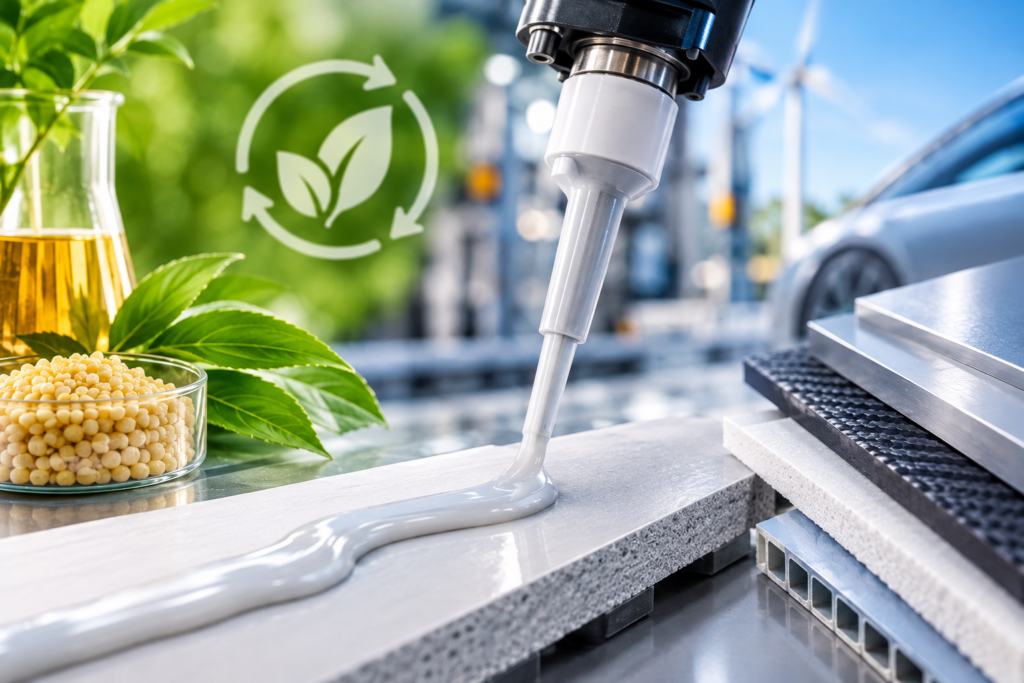
Sustainability is playing an increasingly central role in the development of the next generation of adhesives and sealants. The industry’s evolution is being driven by the search for renewable raw materials, emissions reduction, more efficient manufacturing processes, and the need to ensure reliable long-term performance. These are the key findings of an analysis published by ASI Adhesives & Sealants and authored by Ralph Barthel, which identifies the main trends set to shape the market.
According to the analysis, sustainability is no longer an ancillary consideration but a design criterion that must be integrated with technical, economic, and regulatory requirements. Manufacturers are exploring bio-based materials, low-volatile organic compound (VOC) formulations, and solutions aligned with the principles of the circular economy. The challenge is to develop products that reduce environmental impact without compromising adhesion, flexibility, chemical resistance, or durability.
Hybrid Technologies and New Materials
Hybrid technologies and new materials are another major driver of innovation. Systems based on silane-modified polymers and hybrid polyurethane formulations make it possible to combine the properties of different chemical platforms, offering versatility, weather resistance, and compatibility with a range of substrates. These solutions can also simplify formulation and inventory management, improving efficiency throughout the supply chain.
The growing use of lightweight materials, such as aluminum, composites, and engineering plastics, in the transportation, construction, and industrial sectors is also influencing product development. Bonding these materials requires specialized technologies capable of addressing differences in surface energy and thermal expansion while ensuring long-term reliability.
At the same time, the need to increase productivity is driving demand for fast-curing systems, including UV-curing technologies, moisture-activated systems, and dual-curing solutions. The goal is to reduce processing times and facilitate automation without compromising final strength or bond quality.
Durability remains an essential requirement. Adhesives and sealants must retain their properties even after prolonged exposure to moisture, UV radiation, chemicals, temperature fluctuations, and mechanical stress. As a result, advanced testing methods and accelerated aging programs are playing an increasingly important role in performance evaluation and the prevention of premature failures.
Innovation is also being driven by digitalization. Modeling tools, automated testing, and data analysis help formulators optimize formulations, accelerate development, and improve quality consistency. These factors are complemented by regulatory pressures, particularly those relating to emissions, workplace safety, and environmental compliance, which are encouraging the search for alternatives to traditional materials.
Against this backdrop, the future of the sector will depend on the ability to integrate these trends. Sustainability must go hand in hand with performance, manufacturing efficiency, and long-term reliability. The most competitive solutions will be those that meet environmental and market demands without compromising product quality or functionality.
Industry professionals will meet at ABS Europe 2026 – Adhesives Bonding & Sealants, the first event dedicated to adhesives, glues, sealants, foams, tapes, resins, coatings, laminates and films in Italy and the Mediterranean region, taking place from October 27 to 29, 2026, at Vicenza Exhibition Center.