
Data Centers and Artificial Intelligence: a New Growth Driver for the Adhesives Market
7 September 2026
REMAK at ABS Europe 2026: technical solutions for industrial assembly
9 September 2026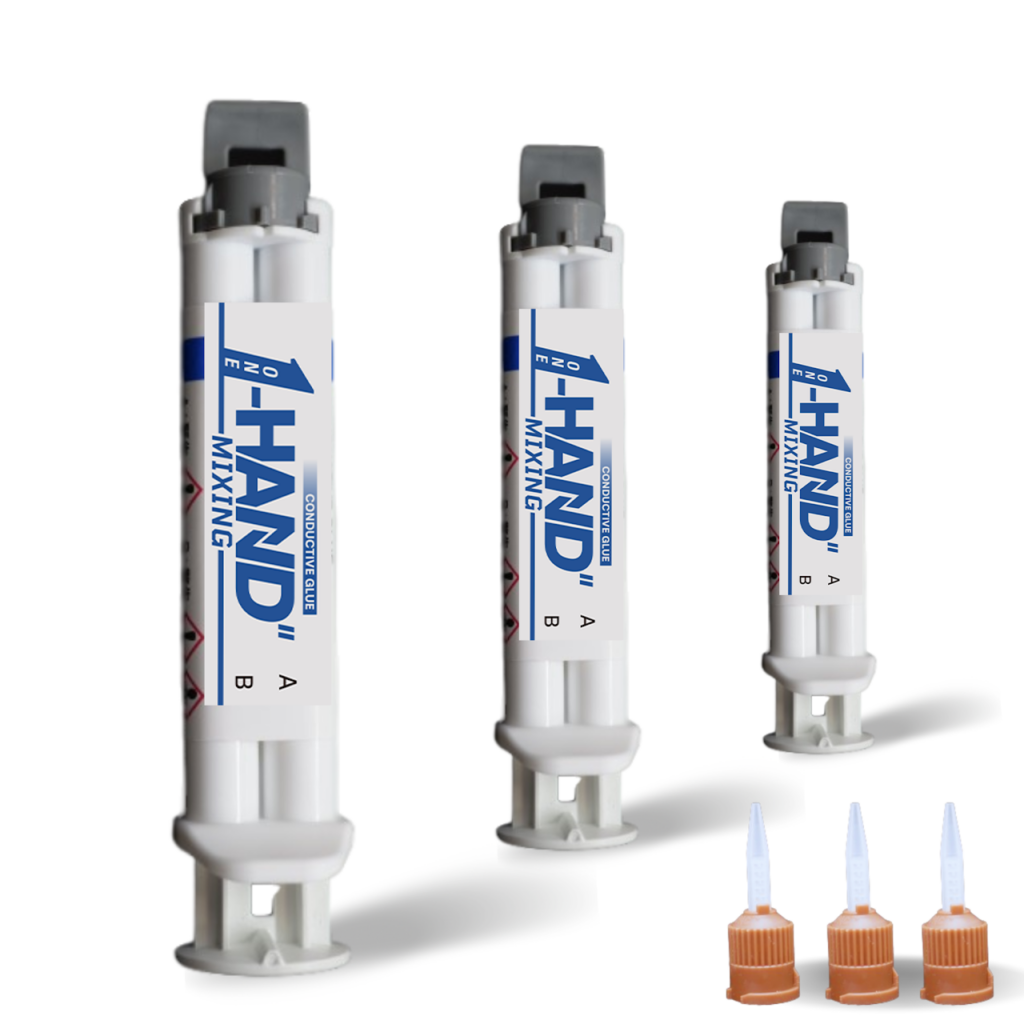
The increasing miniaturization of electronic devices is encouraging manufacturers to explore alternatives to traditional assembly methods. In this context, conductive adhesives are attracting attention for applications that require both electrical connectivity and mechanical bonding, such as ground (GND) connections and the bonding of components used for electromagnetic interference (EMI) shielding.
Pelnox, a manufacturer and supplier of epoxy, polyurethane, silicone and conductive resin products, is evaluating the use of these technologies inside electronic devices. Among the solutions under consideration is One-Hand Mixing, a two-component conductive adhesive with an integrated mixing system, designed for applications where conventional joining techniques may be difficult to implement.
The Role of Ground Connections
GND connections electrically link enclosures, shielding components, printed circuit board ground planes, cable shields and other conductive elements. In addition to providing a current return path, proper grounding can help control electromagnetic interference and electromagnetic compatibility (EMI/EMC), protect against electrostatic discharge (ESD), and maintain a stable reference potential.
Traditionally, these connections are made using soldering, screws and studs, spring contacts, or conductive gaskets. However, the continued development of increasingly compact and lightweight electronic products is creating new design challenges.
The growing use of plastic or plated-plastic enclosures, combined with the presence of heat-sensitive components such as flexible printed circuits (FPCs) and sensors, can limit the use of certain conventional assembly techniques.
An Alternative to Traditional Joining Methods
Conductive adhesives can combine electrical connection and mechanical bonding in a single process, without the heat typically associated with soldering. As a result, they may offer an interesting option for certain design configurations.
During its evaluation, Pelnox identified consistency in material preparation and application as an important factor. This becomes particularly relevant when bonding areas are very small and only limited amounts of adhesive are required.
In such cases, variations in the resin-to-hardener ratio or incomplete mixing can affect the characteristics of the connection, including contact resistance.
Integrated Mixing for Greater Consistency
The One-Hand Mixing system is designed to simplify this stage of the process. The two adhesive components are pre-filled into a cartridge and mixed through a static mixer as the material is dispensed.
This configuration eliminates the need to weigh the components separately and manually mix them. The adhesive can then be applied as individual dots or as a continuous bead, while curing takes place at room temperature.
The aim is to make the application process simpler and more consistent, particularly in applications requiring precise amounts of material over relatively small areas.
Performance Must Be Evaluated for Each Application
Conductive adhesives are not a universal solution for every grounding application. Where product safety requirements apply, such as in protective grounding, the use of a conductive adhesive alone does not, by itself, guarantee compliance with the relevant standards.
In these situations, performance should be verified on the finished device and, where necessary, the adhesive should be combined with mechanical fastening or redundant grounding paths.
Application-specific testing is also recommended for less critical applications. Parameters to be evaluated include electrical contact resistance, bond strength, stability under temperature and humidity variations, resistance to vibration, and the overall EMC performance of the system.
Applications Under Further Evaluation
Pelnox plans to continue evaluating conductive adhesives across a range of electronic configurations. Areas under consideration include plated-plastic housings, metal enclosures, PCB ground connections, EMI shielding components, and cable shield terminations.
Interest in these solutions reflects a broader trend within the electronics industry: developing assembly technologies that can accommodate increasingly small, lightweight and complex devices while maintaining both mechanical reliability and electrical continuity.
Industry professionals will meet at ABS Europe 2026 – Adhesives Bonding & Sealants, the first event dedicated to adhesives, glues, sealants, foams, tapes, resins, coatings, laminates and films in Italy and the Mediterranean region, taking place from October 27 to 29, 2026, at Vicenza Exhibition Center.